
Stop Managing Tasks, Start Developing People: Why Your AI is Too Nice
Our 400-interaction study shows why general-purpose LLMs fail the "Tough Love" test—and what leaders actually need to drive behavioral change.

TL;DR: Our 400-interaction study reveals specialized coaching AI outperforms ChatGPT, Copilot, and Gemini by 48–108% on behavioral efficacy metrics. While general LLMs excel at being "helpful and harmless," they lack the Accountability Focus and Productive Tension required for real leadership growth.
Executive Summary: To evaluate the Leadership Development ROI of specialized coaching models against general-purpose LLMs, we conducted a controlled study across 25 workplace leadership scenarios. The results reveal a fundamental "Coaching Gap": while general LLMs excel at helping managers document tasks, they struggle to address the behavioral roots of performance. This study on Enterprise AI Coaching demonstrates that specialized models lead in Accountability Focus and Non-Directive Feedback, helping leaders stop managing the work and start developing the person.
Study Methodology
We designed a rigorous benchmarking protocol to compare specialized coaching AI against general-purpose LLMs on real-world leadership development scenarios. This isn't about information retrieval—it's about behavioral change capability.
Platforms Tested: Ren, ChatGPT, Microsoft Copilot, and Google Gemini.
Sample Size: 25 unique workplace leadership scenarios with 4 turns per conversation (400 total interactions).
Evaluation: Double-blind scoring performed by an LLM (Claude), and separately analyzed/validated by Grok, across five performance dimensions on a scale of 1–5.
Key Findings: The Tough Love Gap
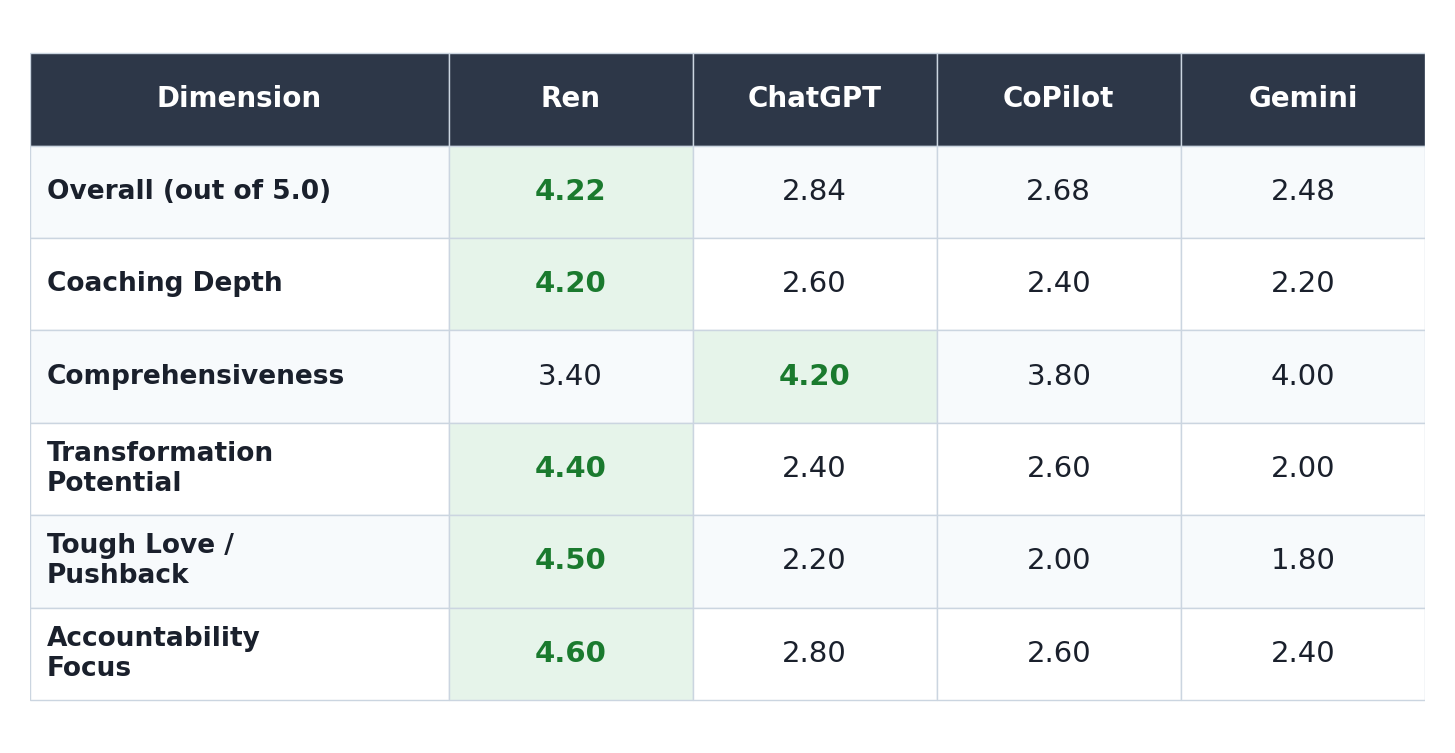
The data reveals a distinct architectural divide in how AI models prioritize user satisfaction versus user growth.
👉 Want to see these differences for yourself? Try Ren free for 7 days and compare the coaching experience firsthand.
Key Findings Summary
Ren demonstrated a significant performance lead in Accountability Focus and Non-Directive Feedback compared to general LLMs.
General-purpose AIs are often limited by Reinforcement Learning from Human Feedback (RLHF), which prioritizes being helpful and harmless, often leading to agreeableness in leadership contexts.
In contrast, specialized models like Ren are optimized for behavioral efficacy, allowing them to challenge a user’s blind spots and introduce the productive tension necessary for effective coaching.
1. The Optimization Paradox: RLHF vs. Behavioral Efficacy
General-purpose AIs are brilliant at information synthesis. Because they are trained using Reinforcement Learning from Human Feedback (RLHF), they are rewarded for being “helpful and harmless”—making them the ultimate collaborative partner for brainstorming or structuring a plan. They provide an exhaustive “what-to-do” list that is technically perfect and professionally polished.
The catch: Because these models are optimized for user satisfaction, they tend to validate your perspective rather than challenge it. They give you the right information, but they lack the “behavioral friction” required to help you apply it to yourself. They focus on the content of the problem while ignoring the conduct of the leader.
In contrast, a specialized coaching AI like Ren is optimized for behavioral efficacy. While a general LLM answers the question you asked, Ren answers the question you didn’t ask. It is architected to make the invisible visible:
Internal Mirroring: It identifies the emotional “leaks” in your language—where you are being vague to avoid conflict or where you are over-explaining to seek validation.
Gap Detection: It reflects back not just what you said, but what you avoided saying. It catches the difference between “I’m busy” and “I’m procrastinating on the hard conversation.”
Productive Tension: By reflecting your internal process back to you, it creates the friction necessary to move from knowing what to do to actually doing it.
While general AI helps you organize the work, specialized AI forces you to own your impact.
2. Information Retrieval vs. Behavioral Change
General LLMs (Consulting Mode): Excellent at synthesizing frameworks (e.g., “How to structure a 1-on-1”).
Specialized AI (Coaching Mode): Specifically architected for pattern-confrontation and identifying conflict avoidance in the user’s own prompts.
Case Study: Breaking the “Deliverable Dead-End”
In our study, we found that general LLMs often act as Taskmasters—they help managers do the wrong thing more efficiently. Most managers try to solve a behavioral problem by assigning a new task, failing to bridge the gap between business results and human growth.
The Scenario: A manager is frustrated with a direct report’s lack of initiative. They tell the AI: “My report is missing deadlines. I’m going to assign him a stricter project tracker and tell him he needs to be more proactive.”
The General LLM Response: Acts as an Efficiency Enabler. It validates the manager’s frustration, calling the plan to add a tracker reasonable and suggesting it be framed as "support + accountability." It focuses entirely on the logistics—cadence, blockers, etc.—helping the manager document the problem without ever questioning if the manager’s own style is the root cause.
The Specialized Response (Ren): Acts as a Coach. It interrupts the focus on the tracker to find the development root: “A project tracker won’t fix a lack of ownership. You’re trying to manage the work because you don’t know how to develop the person. Why is he waiting for your permission to act? Until you address the fear or friction preventing him from taking charge, no amount of tracking will make him ‘proactive.’”
The Transformation: While general AI helps you manage tasks, specialized AI helps you mentor talent. It forces the manager to stop hiding behind “goals” and “trackers” and start having the genuine growth conversations that actually drive those results.
Conclusion: From Documentation to Development
As AI becomes a standard part of the leadership toolkit, the danger isn’t that it will give “wrong” answers—it’s that it will give “safe” ones. General LLMs are programmed to be helpful consultants; they will help you build the perfect project tracker for a struggling employee without ever asking you why you’re afraid to have a direct conversation.
The real value for organizations lies in Specialized Alignment—AI that doesn’t just do what you ask, but tells you what you need to hear to grow. For leaders and HR teams, the takeaway is clear: if you want to manage tasks, use a general LLM. If you want to mentor talent and drive genuine behavioral change, you need a model built for accountability, not agreeableness.
The future of leadership isn’t about better documentation—it’s about better development.
Final Note on Data: This study was led by AI researchers Russell Hanson and Aleksandra Spasic. All scoring and interaction logs from this 400-point study are available for review in our 400-interaction AI Benchmarking Report.
The Takeaway: If you’re ready to move beyond “helpful” AI and experience the “Tough Love” gap for yourself, experience specialized AI coaching with a 7-day free trial of Ren. See how a specialized model can help you move your team from documentation to true development.